
Choosing the Right Security Partner: Depth, Focus, and What Actually Matters

Illustrated by Jeff Prymowicz
Organizations have more security partners to choose from than ever before. Some lead with technology. Some lead with scale. Some lead with large teams and broad service portfolios.
The challenge isn't finding a firm that can identify issues.
The challenge is finding a partner that can help you understand what matters, separate signal from noise, and actually reduce risk.
That's where the differences between firms become much more apparent.
A Practitioner-Led Approach to Cloud and Application Security
Cloud Security Partners was founded in 2017 with a clear mission. We help organizations solve complex cloud and application security challenges with clarity, precision, and practical execution. What started as a boutique consultancy has grown into a trusted partner for startups and enterprises alike, focused on securing what matters most.
Our team has deep expertise in cloud-native software and infrastructure security. We're equally comfortable getting hands-on with the technical work and shaping the strategy around it. From early-stage startups to Fortune 20 enterprises, we've built programs that reduce risk without slowing the business down.
That range of experience matters. It gives us perspective on what works at scale, what works in fast-moving environments, and how to bridge the gap between the two. Our leadership team comes from companies like Capital One, GitHub, and Salesforce, where security operates under serious pressure and at significant scale. We've also built and scaled cloud and application security programs from the ground up, so we're not just assessing environments. We understand what it takes to operationalize security and make it sustainable, which matters for clients building or maturing their internal capabilities.
Core Principles That Shape Our Work
A few core principles shape how we work with every client.
We're squarely focused on risk discovery and remediation, not just identification. Our work is measured by the risks we uncover and, more importantly, the ones we help eliminate.
Our approach is AI-enabled but human-verified. We use automation to increase coverage and move faster, but every finding gets validated by an experienced engineer. That balance reduces false positives and makes sure critical issues don't slip through.
We staff engagements with senior engineers and experienced practitioners. The people doing the work understand how real attackers operate, and they bring that perspective directly into the assessment.
We also stay flexible. Every organization has a different threat model and risk tolerance, so we tailor our approach instead of forcing clients into a rigid methodology.
The results back this up. Across our engagements, we typically uncover 20 to 30 percent more risks than previous vendors, and help clients resolve up to 50 percent more of the issues identified. That gap is the difference between an assessment that produces a report and one that actually moves the needle on security posture.
Remediation Is Where the Real Difference Shows Up
Most firms can find issues. Far fewer help fix them.
Where many vendors hand off a report and step away, we work alongside our clients' engineering teams to remediate the issues we identify. That happens directly in the code, in the cloud environment, and in the CI/CD pipeline. Hands-on remediation work is often the biggest gap between security vendors, and it's consistently where we see the most impact for our clients.
It's also where our practitioner-led model pays off. Remediation requires people who can read the code, understand the architecture, and work alongside engineering teams without slowing them down. That isn't work a platform can do on its own.
AI Security as a Core Capability
AI is one of the fastest-moving areas in security today, and it's an area where we've invested heavily. Not as a platform play, but as a core part of our expertise.
Our team has hands-on offensive AI experience, including red-teaming and hacking AI and ML systems, and breaking state-of-the-art models under adversarial pressure. On the defensive side, we've designed and secured AI environments for Fortune 20 organizations, so we understand what's required when AI is being deployed at scale and under real regulatory and business pressure. We also do end-to-end AI threat modeling and architecture reviews across the full AI lifecycle, catching design issues early, where they're far cheaper to fix than in production.
That dual perspective, both offensive and defensive, practical and architectural, is what we bring into every engagement where AI is in scope.
Experience That Translates Into Outcomes
Across our team, we've performed hundreds of cloud and application security assessments. That depth lets us quickly recognize patterns and prioritize what actually matters. Every consultant on our team also holds multiple engineering and security certifications, reflecting the level of rigor we bring to the work.
The takeaway is simple. When you work with Cloud Security Partners, you're working with practitioners who have operated at scale, built real programs, and know how to turn security into something that works in practice.
Where the Market Is Heading
As organizations evaluate security partners, two distinct trends have emerged in how services are delivered.
Some firms are investing heavily in proprietary platforms and AI-driven capabilities designed to scale testing, increase coverage, and improve efficiency. Others have expanded through scale, broadening their service portfolios across advisory, managed security, and risk functions to serve as one-stop consolidated providers.
Both approaches reflect real market demand. But they also introduce tradeoffs.
As more emphasis is placed on platform-led delivery or broader service portfolios, the role of deeply embedded, hands-on practitioners can change. In some cases, the platform or the breadth of offerings becomes the focal point, and human expertise ends up adapting around it rather than leading the engagement.
For organizations operating in complex cloud and application environments, the question becomes whether these shifts actually improve outcomes, or whether they create distance from the nuanced, context-driven analysis that this work requires.
A Look at Bishop Fox
Bishop Fox has long been recognized as a leader in the offensive security space, with nearly two decades of experience in penetration testing and red teaming, and a strong reputation for technical depth.
In recent years, the firm has placed increasing emphasis on its platform-driven approach, particularly with its Cosmos AI offering. That shift reflects a broader industry trend toward scaling security testing through automation and proprietary technology, with Bishop Fox highlighting gains in speed, coverage, and efficiency.
As that evolution continues, it represents a change from the firm's historically practitioner-led model. When much of the testing work is mediated through a platform, the role of the practitioner can shift from leading the engagement to supporting it. For organizations with complex, custom, or rapidly evolving cloud and application environments, that shift can matter. The most impactful findings often come from a human who can pivot in real time based on what they're seeing.
Platform capabilities can extend reach, but they can also reshape how engagements get executed and where expertise is applied. For buyers, it's worth asking a simple question. When you engage a firm built around a platform, how much of the work is actually being done by a senior practitioner pivoting based on what they see, and how much is being driven by the platform itself? The answer often shapes the outcome more than the methodology described in the statement of work.
A Look at NCC Group
NCC Group has long been recognized as a respected global leader in cybersecurity, with a strong heritage in penetration testing, assurance, and risk management services.
As the firm has grown, it has significantly expanded the breadth of its offerings. Today, NCC Group delivers services that span advisory, consulting, managed security, and broader risk and compliance domains. That evolution aligns with the needs of large organizations looking for consolidated providers, but it also represents a shift from the more specialized, deeply technical focus that originally defined much of its reputation.
With that scale and breadth, maintaining consistency in delivery across teams, regions, and service lines can become more complex. For clients, that can translate into real variability in experience from one engagement to the next, depending on which team is assigned and where they sit.
Some clients prioritize continuity. Working with the same senior practitioners across multiple engagements, rather than rotating teams, often translates directly into faster, more contextual results, especially in complex cloud and application security environments.
It's worth asking, when you sign with a large global firm, do you know which team you'll get, and will it be the same team next time? In specialized work, that continuity often matters more than the breadth of the firm's overall capabilities.
Comparing the Approaches
Different firms take different approaches to security work, and each comes with its own set of tradeoffs. The table below summarizes how those approaches typically compare.
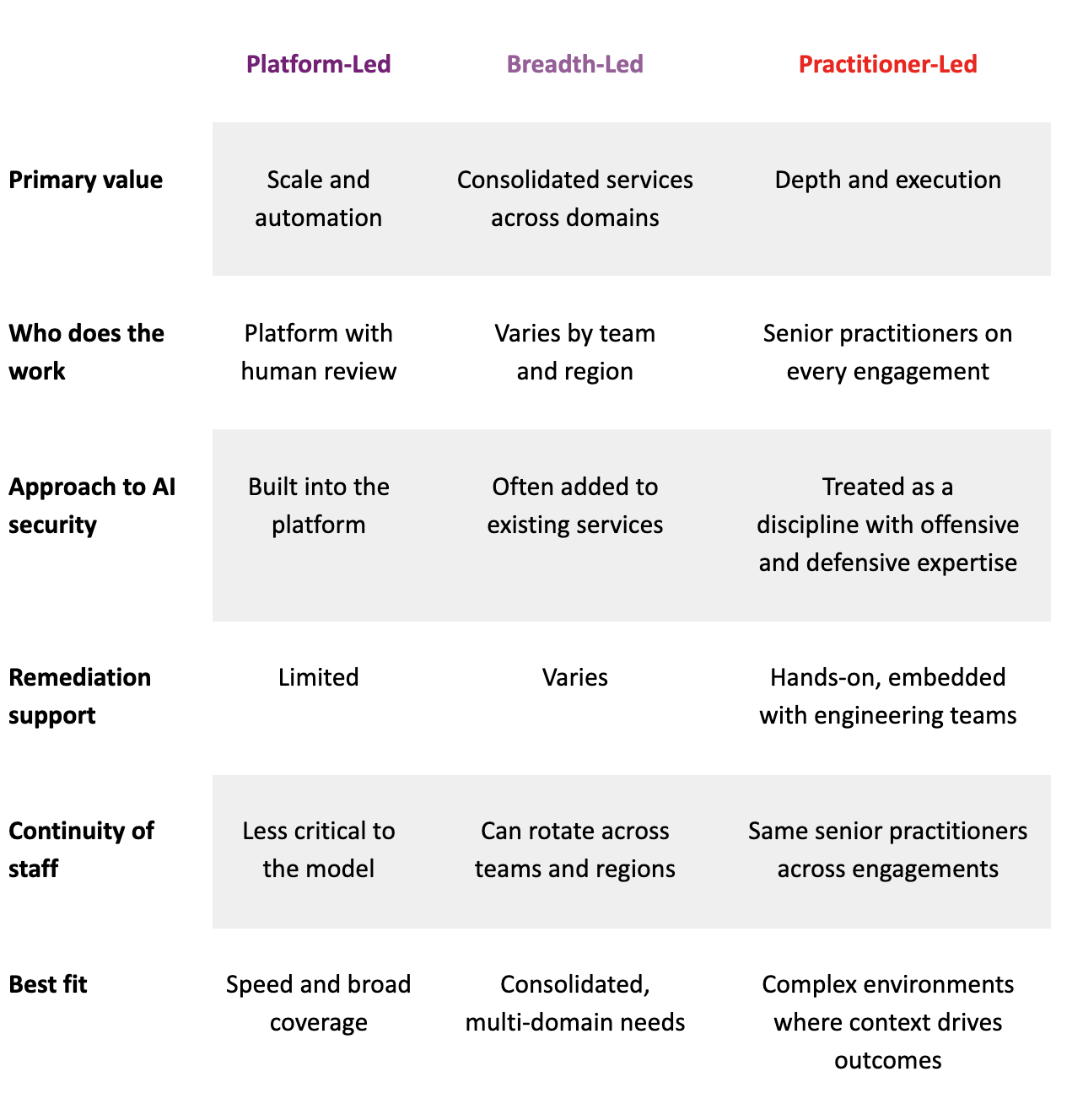
None of these approaches is universally better. The right fit depends on what you're trying to accomplish and the complexity of the environment you're securing.
Questions Worth Asking Any Security Partner
Regardless of which firm you're considering, there are a handful of questions worth asking when choosing a penetration testing provider or security partner.
Will you work with the same people throughout the engagement, or will the team change once the contract is signed?
How much of the work is done by experienced practitioners pivoting versus being driven by a platform?
When issues are identified, will the firm help you fix them, or simply hand you a report?
If AI security is part of the conversation, is it something they've been doing in practice, or is it a new capability they've added to keep up with the market?
And perhaps most importantly, do they have real depth in the areas that matter most to your organization?
These aren't gotcha questions. They're the things that usually determine whether an engagement creates meaningful security improvements or becomes another report that gets filed away and forgotten.
We built Cloud Security Partners around clear answers to every one of those questions. The same senior practitioners stay involved from beginning to end. We use AI to help our team move faster and cover more ground, but experienced humans are always leading the work. We don't stop at identifying problems; we work alongside engineering teams to help solve them. And when it comes to AI security, our perspective comes from years of hands-on offensive and defensive work, not from a feature added to a slide deck.
What This Means for Security Leaders
Choosing the right partner ultimately comes down to what you're trying to accomplish.
For some organizations, speed, scale, and broad coverage may be the highest priorities. In those situations, larger firms or platform-driven delivery models may be the right fit.
But for organizations dealing with complex cloud environments, critical applications, and real-world security challenges, experience and judgment still matter. Knowing where to focus, understanding the context behind a finding, and helping teams actually address risk often has a greater impact than simply identifying more issues.
That's the approach we've taken at Cloud Security Partners.
Security has never been just about finding problems. It's about understanding which problems matter, prioritizing them appropriately, and helping organizations reduce risk in a meaningful way. That's where we spend our time, and it's where we believe experienced practitioners make the biggest difference.
If that approach resonates with your organization, we'd be happy to talk. Reach out!
Stay in the loop.
Subscribe for the latest in AI, Security, Cloud, and more—straight to your inbox.
